![]() Teamfight Tactics
Teamfight Tactics
 Teamfight Tactics
Details
 |
|
| Playtime | Not Played |
| Last Activity | Never |
| Added | 04/05/2025 20:14:37 |
| Modified | 26/03/2026 14:53:43 |
| Completion Status | Not Played |
| Library | Epic |
| Source | Epic |
| Platform | Android iOS Macintosh PC (Windows) |
| Release Date | 26/06/2019 |
| Community Score | 82 |
| Critic Score | 80 |
| User Score | |
| Genre | Board Strategy |
| Developer | Riot Games |
| Publisher | Riot Games |
| Feature | Multi-Player |
| Links | PCGamingWiki Official site IGDB Wikipedia |
| Tag | Free to Play Hextech Engine No Cloud Saves Real-time |
Description
Teamfight Tactics (TFT) is an auto battler game developed and published by Riot Games. The game is a spinoff of League of Legends and is based on Dota Auto Chess, a mod for Dota 2, which in turn was inspired by Mahjong. Players face online against seven other opponents in a team building competition to be the last one standing.
The game released as a League of Legends game mode for Windows and macOS in June 2019 and as a standalone game for Android and iOS in March 2020, featuring cross-platform play between them.
Gameplay
Similar to Dota Auto Chess, the game centers around eight players who construct teams to fight one another and be the last player standing. The battlefield consists of hexagons, where players can strategically place units on the hexagons on their side of the game board between rounds. During each round, a player is randomly matched against another player or against computer-controlled enemies that drop loot. The round initiates a battle with the two teams which lasts until units of one team are all defeated or a time limit is reached. Losing the round will result in the player losing health as a penalty based on the number of enemies remaining and the number of rounds completed.
The game consists of several stages, with each stage consisting of seven rounds. After round three of each stage, players will participate in a "Carousel" event. A Carousel event allows players access to a free, shared rotation of units with random equipped items to select from. Players are allowed to select one unit from the rotation with the pick order determined by the health remaining of each player sorted from lowest to highest and assigned to two players at a time. If there are players with the same health, the game will randomly choose the order. On the last round of each stage, players will face computer-controlled enemies. The exception to the stage rules is the first stage, which consists of three rounds of computer-controlled enemies.
Teamfight Tactics periodically updates its unit roster. Every three months there is a partial rotation, referred by Riot Games developers as a mid-set update, rotating out traits and units which are problematic. As Teamfight Tactics is a game mode of League of Legends, its patch numbering follows the same as its parent game rather than being labelled differently.
Units
Units in Teamfight Tactics are directly ripped from the champions of League of Legends in which they inherit skins, abilities, and role. Each unit can share "traits" with other units that activate synergies to benefit combat against other players (i.e. granting additional combat power, granting gold). Teamfight Tactics regularly updates its unit pools in the form of content updates called "sets".
Unit rarity is separated into category's based on cost, typically ranging from 1 to 5 gold per unit and higher rarities possessing more powerful abilities. Each unit starts as a "1 star" and is able to be upgraded to "2 star" if three copies of the same unit are found in the shop. A unit can be further upgraded to "3 star" by collecting three "2 star" copies (9 units in total). Upgrading a unit upgrades their stats and abilities.
With some exceptions, units have a health bar and a mana bar. When a unit's health reaches zero, they are effectively removed from the round. When a unit's mana bar is full, they cast a unique ability. Some units may start the round with some percentage of their mana bar full, but units generally start the round with no mana unless equipped with special items.
Items play a pivotal role in team fight tactics by providing bonuses to the holder (such as damage, health and armour) as well as granting them, or other units around them, special effects. Items are separated into three main categories: components, completed items and miscellaneous items. Components offer comparatively lesser buffs to the holding unit and typically do not offer any special effects, however when combined with another component on the same unit, will transform into a completed item. Completed items typically offer better stats and unique effects to strengthen the players units. Items can primarily be gained through carousel rounds, computer controlled enemy loot combat rounds or through augments. Each unit has three equip-able inventory slots that can be used to hold any combination of completed items, components and special items such as emblems, which grant units additional traits.
Players accumulate gold during rounds and can save it to build interest Players can also gain additional income per round with "streak bonuses" by either winning multiple rounds in a row or losing multiple rounds in a row. With gold, players can either reroll the five units automatically offered to them in their shop at the start of each round, purchase units from their shop or purchase experience points to increase their level. The higher a player's level, the more units they can place on the board. Higher player levels also increase the average rarity of units in the shop.
Augments were introduced to the game with the release of Set 6: Gizmos & Gadgets and has been a mainstay mechanic for current sets. These are in game effects that are selected by the player on certain rounds and provides various buffs (in-combat stat bonuses), resources (gold, items and units) or other modifications (modifying interest rate, increased unit limit, increased Tactician health). Augments range in rarity from silver, gold and prismatic, with each tier awarding and unlocking better potential benefits. For each augment round, players are given a choice of three augments to pick from.
Development and release
Pre-Release
Teamfight Tactics origins were directly inspired by the rising popularity of Dota Auto Chess and started as a project with a 12 developer team. The goal of the developers was to directly improve Dota Auto Chess by improving the design, utilizing their collective experience, and make it more engaging. The timeline was to complete the project in 18 weeks: 8 weeks for prototyping and 10 weeks for release.
The game was released within the League of Legends client for Windows and macOS on June 26, 2019, and as a standalone app for Android and iOS on March 19, 2020. By September 2019, the game had over 33 million monthly players with 1.72 billion hours of accumulated game time.
In December 2024, Riot Games launched Golden Spatula, a version of Teamfight Tactics for Android and iOS for Thailand, Malaysia, and Singapore. This version offers collaborations and exclusive cosmetics.
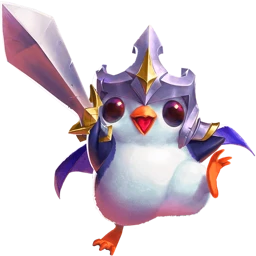
Similar to other free-to-play games from Riot, Teamfight Tactics monetization base around cosmetic consumptions and season passes. It has its own store separate from League of Legends. The player's controllable avatar, called a Tactician (previously "Little Legend"), can be customized by buying avatar cosmetics from the store. Those can be upgraded by buying from loot boxes called "Little Legend eggs" or through star shards that can either be bought in the store or earned from the season pass that lasts for the duration of the set. Now, in addition to "Little Legend eggs", the treasure tokens system was introduced as a method to obtain little legends. Typically, the treasure tokens are mainly used to roll for a rare, highlighted tactician. Since the release of the Chibi Champions, Riot refers to these avatars as Tacticians, though the term Little Legend is still commonly used. Note, however, Tactician had been a term to refer to players before that.
Other than the controllable avatar, Teamfight Tactics also has skins for the player board where the combat between players is played. The boards can be bought directly or through bundles in the store. Boards also come with different prizes, while the cheap ones only change the model of the board, expensive ones are interactive and react to player achievement. Beside that, there is Boom, cosmetic that modify the damage particles of the Tactician. All Booms released so far are rewards of Battle Pass.
In November 2024 to promote the release of the newest season of Arcane a new type of tactician was introduced referred to as Unbound. Unbound Champion tacticians are the purest embodiment of that champion at the height of their power. Unlike Chibi Champions or Little Legends, Unbound Champions feature designs that are grounded in the ultimate version of a champion's power fantasy, personality and backstory.
Riot expanded the cosmetic lineup in April 2025 with the release of Portals together with Cyber City. Portals are a cosmetic feature that changes the visual effects shown when a Tactician travels through the map. They can be bought in the mythic store or earned from the Battle Pass. Portals are offered in two tiers: Standard Portals priced at 1 Mythic Medallion and Legendary Portals priced at 3 Mythic Medallions.
Besides Normal and Ranked game modes, Riot offers different game modes with different play styles.
Teamfight Tactics is being supported by Riot Games post-launch, with regular balance updates to keep the game fair and entertaining, as well as Little Legend egg drops. The game also updates the game in a big way with "sets". Sets give players more incentive to play the game, changing synergies and introducing new ones, rotating various League of Legends champions into the roster, as well as dropping new season passes. News regarding the current set can be found at the Teamfight Tactics news website.
Esports
TFT Championships
- TFT Vegas Open (2023)
- TFT Macao Open (2024)
- TFT Paris Open (2025)
- TFT Pro Circuit (TPC)
- TFT Open Championship (TOC)
- JCC Open Championship (JOC)
- Esports World Cup (EWC)